I don’t know about you but I feel that the world in just the last few months has gotten really strange. Blogger Blake Shields shares my views about what is going on; “AI is advancing faster than most of us can comprehend. Our phones know an uncomfortable amount about us. Housing is absurdly expensive while some guru still explains how skipping a $12 sandwich will eventually get you the keys to a three bedroom colonial… We wake up and reach for a device (cell phone) containing the anxiety of the entire planet.
Before breakfast, we can watch a war overseas, read that AI is coming for our jobs, discover that our breakfast is killing us, learn that the economy is collapsing and find out some harmless household product has apparently been poisoning us since 1983.”
The algorithms’ that increasingly control our daily lives and what information we see, and don’t see, also capture data about us that most of us would never have sanctioned a mere 25 years ago. It’s also propelling our cave age brains into a brave new world that is truly overwhelming for most of us. Most of us today wake up and immediately look at a screen – Messages; Notifications; Emails;
Social media, Apps of various kinds; News, etc. And how much of it is positive? “Your feed can frighten you about the economy, show you someone with a better body, sell you the supplement that supposedly fixes your ill, introduce you to a millionaire explaining why you’re lazy, then finish with someone predicting the end of civilization. That’s a hell of a Monday morning… I don’t think the answer is to spend every waking hour apprehensive about what happens next. If anything, that would make us even easier to control. Fear consumes attention just as efficiently as entertainment does.” Blake Shields.
I think the key to moving forward is to acknowledge all this strange stuff going on BUT continuing to make our own decisions about where we put our attention. We are the change we need, but for whatever reasons we may have, we collectively refuse to accept that simple yet profound idea. The two images attached here (one, two) about change and power convey this issue nicely.
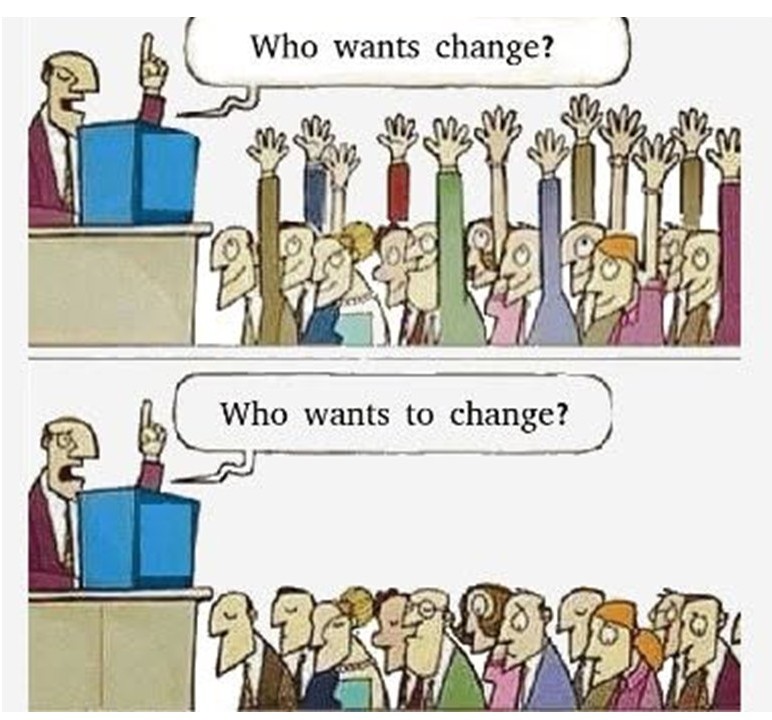
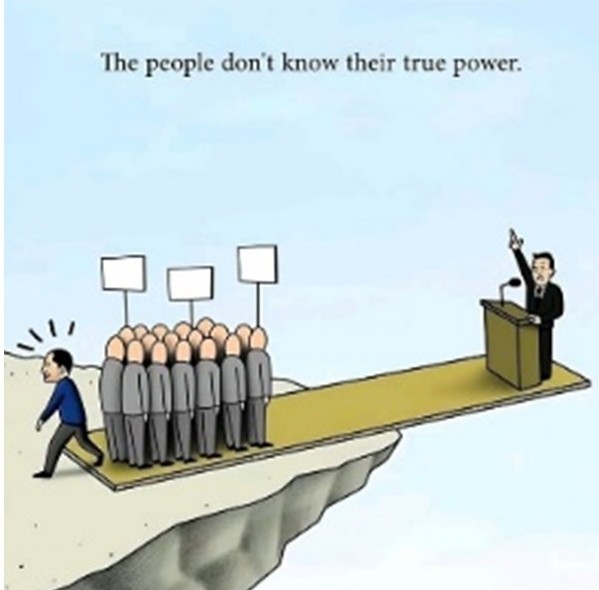
Wendell Berry died recently, he was a profound social critic and thinker about humanity’s actions towards the world. His writings still stretch our minds if we let them open to recognizing our collective hubris; “Our destructiveness has not been, and is not, inevitable. People who use that excuse are morally incompetent, they are cowardly, and they are lazy. Humans don’t have to live by destroying the sources of their life. People can change; they can learn to do better. All of us, regardless of [political] party, can be moved by love of our land to rise above the greed and contempt of our land’s exploiters.”
He once wrote a series of simply, yet profound, questions to bring our beliefs to the surface to be acknowledged. “Wendell Berry was ‘not’ playing when he wrote this. The answers might seem self-evident to most of us, but are they really? He’s also asking those of us who really care about all of this how much of it we’re ignoring when it happens somewhere else, to someone else” Jabob Nordby. Wendell Berry asked;
- How much poison are you willing to eat for the success of the Free-Market and global trade? Please name your preferred poisons.
- For the sake of goodness how much evil are you willing to do? List the names of your favorite evils and acts of hatred.
- What sacrifices are you willing to make for culture and civilization? Please list the monuments, shrines and works of art you would most willingly destroy.
- In the name of patriotism and a flag, how much of your beloved land are you willing to desecrate? List the mountains rivers, towns, and farms you could most readily do without.
- State briefly the ideas, the ideas or hopes, the energy sources, the kinds of security, for which you would kill a child. Name, please, the children you would be willing to kill.
How much damage and harm becomes acceptable when enough money, jobs and infrastructure of a destructive society sit on this side of what currently exists versus what you would like to exist? No small question. “It’s all a question of story. We are in trouble just now because we do not have a good story” Thomas Berry. We are completely wrapped up in a story of being hedonistic consumer-materialists focused on standard of living. We find it hard to believe that another story of a caring-sharing society could actually describe who we really want to be. Let’s not fool ourselves, we are the stories we tell ourselves. We allow the powers that be to control us with their narratives that diminish our authentic selves; because we tell ourselves that kind of story that thrives from fear – a story of victimhood and survival mode, living with scarcity always lurking in the shadows. In this kind of story, being alone means isolation and lack of social safety nets or safety in general. That’s how the Cabal keep us polarized and dependent on their system.
But it doesn’t have to be like that. When we choose authenticity, we also choose personal sovereignty not only for ourselves but for all life. Being part of a sharing collective is a choice to thrive as both an individual and a true community. All life on Earth is part of a large ecosystem that works inter-relationally from the smallest ecosystems systems to the global one. Re-integrating back into this global system is a simple choice to disengage from the destructive human dominance mindset with global dominance at its core. As always with me it is a worldview change. A change that begins with a different story about who we are in relationship with the world. Again, I come back to our need to understand our beliefs for they supply the meat to our stories. As Kurt Vonnegut said, “Question the stories you’ve been told about yourself. The center is comfortable. The edge is clarifying. The center tells you you’re right. The edge shows you how small your rightness is. The center gives you certainty. The edge shows you the questions you are not asking… A purpose of human life, no matter who is controlling it, is to love whoever is around to be loved.”
Blogger Brian Gibb comments on the problem of unattached individuality rather than understanding the benefits that collectivity brings to authentic and sovereign individuals; “Reality stubbornly refuses to respect the boundaries we draw around it. A forest is inseparable from soil, fungi, rainfall, carbon, microorganisms, insects, animals and atmosphere. A city depends upon energy grids, watersheds, food systems, transportation networks, ecosystems and millions of human relationships. A human being emerges from biological, cultural, linguistic, technological and ecological relationships extending far beyond the boundary of the skin.” We are all a collective, yet we can still be contributing and sovereign individuals within the collective system. We are better together than as isolated individuals.
This change can occur with lots of us choosing ‘Collective Refusal,’ which is a political and social practice in which a group of people jointly decline to participate in, support, or legitimize systems, policies, or practices they view as harmful, oppressive, or unjust. It is not an individual act of protest, but a coordinated, shared refusal that aims to challenge and transform the structures or conditions in question. Collective refusal works because:
- Creates solidarity across diverse groups facing similar harms.
- Disrupts normalization of oppressive systems by refusing to participate in them.
- Opens space for alternative practices that align with more just, equitable, or sustainable values. Acme.journal.org.
In short, it’s how we begin the transformation.
Historically, Collective Refusal has been a workable tool that the oppressed have used many times against autocratic systems – whether that be slave revolts in ancient Rome, peasant revolts in medieval times, or national workers strikes in more recent times. It always worked on the occasions when enough people declined the unacceptable societal systems controlling them. “And it happened with surprising speed such that everyone, including the refusers, were surprised. That is not romance. It is the historical record” Chris Goode. If it is so successful, why do we not see it as a standard tool in the peoples’ repertoire against all corruptive systems? It’s not because of the lack of will, but more about the isolated sense each of us feels when we feel a grievance – we feel alone without realizing just how many others feel the same way. The hard part is about communicating and coordinating those desires to create a different society. But it is very doable. And there are a majority of us wanting to create a better future.
To Be Continued ………………..
0 Comments